Table of Contents
ToggleThe housing market has shifted dramatically for retirees and empty nesters seeking a fresh start. Senior tiny home communities are redefining what retirement living looks like, offering an alternative to sprawling suburban houses or expensive assisted living facilities. These purpose-built neighborhoods combine affordability, low maintenance, and community engagement in compact, efficient spaces. Whether you’re 55 and ready to simplify or helping a parent explore downsizing options, understanding what senior tiny home communities offer can open doors to a lifestyle that’s both practical and fulfilling. This guide walks you through what to expect, why they appeal to so many, and how to find the right fit for your needs.
Key Takeaways
- Senior tiny home communities provide self-contained homes (400–1,200 sq ft) designed specifically for adults 55+ with ownership options and shared amenities that foster community connection.
- Downsizing to a tiny home reduces monthly carrying costs by 30–50% through lower mortgage payments, property taxes, utilities, and homeowner’s insurance while freeing up significant equity from your current home.
- These homes are engineered for aging in place with single-floor layouts, wider doorways, accessible bathrooms, and proximity to neighbors for faster emergency response and optional healthcare support.
- When evaluating senior tiny home communities, prioritize location near healthcare and shopping, verify construction standards and warranties, assess HOA financial stability, and review resale market dynamics before committing.
- Visit communities multiple times at different times of day, talk to current residents, and hire a real estate attorney to review contracts and protect yourself from high-pressure sales tactics or unfavorable terms.
What Are Senior Tiny Home Communities?
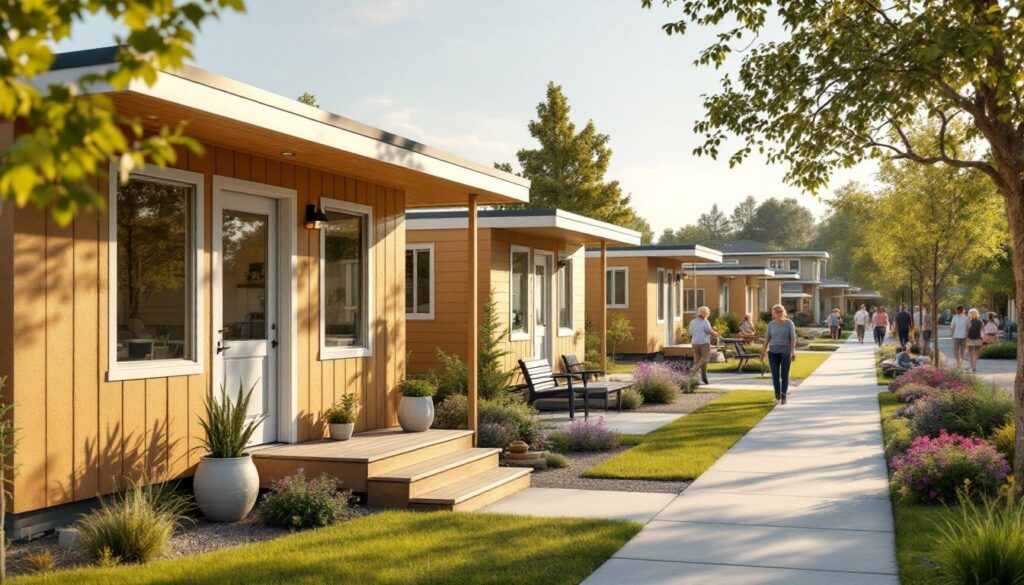
Senior tiny home communities are residential developments specifically designed for adults 55 and older, featuring compact, self-contained homes typically ranging from 400 to 1,200 square feet. Unlike age-restricted apartment complexes or traditional retirement communities, these neighborhoods consist of individual homes on dedicated lots, each with its own entrance, typically a small yard or patio, and full ownership or long-term lease arrangements.
These communities are popping up across the country as developers recognize the demand from retirees who want independence without the burden of a 3,000-square-foot house. Homes are usually manufactured, modular, or conventionally built using efficient floor plans optimized for aging in place. Many communities offer shared amenities like clubhouses, fitness centers, walking trails, and gathering spaces that foster neighborhood connection.
What sets them apart from standard mobile home parks or RV communities is the quality and permanence. Most senior tiny home communities feature higher construction standards, professional management, and covenant-protected neighborhoods that maintain property values. Residents own or lease their homes, not just the space underneath them, which creates real equity and stability.
Why Tiny Homes Appeal To Retirees
The appeal isn’t just nostalgia or trend-chasing, it’s rooted in practical reality. A typical three-bedroom house requires constant upkeep: roof repairs, gutter cleaning, HVAC maintenance, lawn work, and rising utility bills. For retirees on fixed incomes or those dealing with mobility challenges, this burden becomes overwhelming. A tiny home cuts that workload dramatically. Heating and cooling costs drop substantially. Exterior maintenance shrinks. Interior cleaning takes an afternoon instead of a weekend.
Beyond the physical labor, there’s the psychological freedom. Many retirees report feeling liberated when they downsize, less clutter to manage, fewer decisions about what to keep, and a fresh chapter without the emotional weight of a longtime family home. It’s not giving something up: it’s gaining back time and headspace.
Community is another massive draw. Unlike isolated suburban living, tiny home communities build connection by design. Neighbors are nearby, shared activities happen regularly, and there’s built-in social infrastructure. For people living alone after a spouse’s passing or those moving to a new area, this matters enormously.
Key Benefits For Aging In Place
Most senior tiny homes are engineered with accessibility in mind. Single-floor layouts eliminate stairs: open floor plans make movement easier: bathrooms are wider to accommodate walkers or wheelchairs: and grab bars or reinforced walls for future installation are standard. Kitchens are compact but functional, easier to work in, less reaching and bending. Doorways meet ADA-compliant widths, even if not explicitly required.
The community health infrastructure adds a safety layer. Emergency response times are faster when neighbors are close. Many communities have partnerships with local healthcare providers or on-site nurse stations. Some offer optional services like meal prep, transportation, or light housekeeping without requiring full-time care. This flexibility lets people stay independent longer while knowing support is available if needed.
Financial Advantages Of Downsizing
The math is compelling. A retiree selling a $400,000 home and buying a $200,000 tiny home frees up $200,000 in equity, money that can fund travel, healthcare, hobbies, or family gifts. Even after closing costs and moving expenses, the net gain is substantial and typically available right when people need it most.
Monthly carrying costs shrink across the board. Mortgage payments (if financed) are lower. Property taxes drop because assessed value decreases. Homeowner’s insurance is cheaper on smaller structures. Utilities, electricity, gas, water, fall 30–50% simply because there’s less square footage to heat, cool, and light. HOA fees in senior communities typically range from $100 to $400 monthly, depending on amenities, which often beat what a homeowner pays in maintenance, landscaping, and repairs on a traditional house.
Many senior communities offer fixed HOA fees that don’t increase year-to-year, providing budget certainty in retirement. And unlike traditional housing, where a major repair (new roof, foundation work, AC replacement) can cost thousands unexpectedly, tiny homes sidestep that risk. Builders often include extended warranties or management companies handle structural maintenance.
There’s also a tax angle. Depending on jurisdiction, some downsizing transactions qualify for favorable capital gains treatment or state-level tax breaks for seniors. Consult a tax professional, but the upside is real for many retirees.
Essential Features To Look For
Not all senior tiny home communities are created equal. When evaluating options, start with the basics: location relative to healthcare, shopping, family, and public transit. A charming community 45 minutes from a hospital or grocery store loses appeal fast.
Next, assess the physical homes. Walk through a model and a resale (if available) to get a genuine feel. Check ceiling height, storage solutions, and kitchen flow. Ask about construction standards, are walls insulated properly for your climate? Is the roof rated for local weather (high wind, snow load, hail)? Request documentation of building codes and warranties. A $180,000 home that falls apart in five years is no bargain.
Evaluate the community infrastructure. What amenities exist? Are they well-maintained? Visit during different times, weekday morning and Saturday afternoon, to see actual activity and how residents use spaces. Talk to current residents (the developer should help this). Ask tough questions: How is the community governed? What do HOA fees cover? Are there age or income restrictions beyond the 55+ requirement? What’s the resale market like, can people actually exit if circumstances change?
Financial stability matters. Request audited financial statements from the community’s management company. A poorly-managed development with underfunded reserves will hit residents with surprise assessments. Ask about ownership structure: is it a real estate investment trust, a private developer, or resident-owned? Ownership model influences long-term management and investment philosophy.
Finally, consider future flexibility. Does the lease or deed allow you to rent out the home if you need to relocate? Can you modify the interior? What happens if you need to move to assisted living, can you sell or break the lease? These exit ramps matter more than people realize.
Getting Started: Steps To Finding Your Community
Start your search online through dedicated senior living marketplaces and local real estate agents specializing in 55+ communities. Websites like A Place for Mom, Senior Housing Net, and 55places.com aggregate listings nationwide. But don’t stop there, many excellent smaller communities aren’t heavily marketed online. Local economic development agencies, regional chambers of commerce, and area agencies on aging often have comprehensive directories.
Attend senior living expos in your region. Developers showcase communities, answer questions, and you can see models side-by-side. These events also connect you with advisors, financial planners, real estate attorneys, and social workers, who specialize in downsizing and retirement housing decisions.
Visit communities in person multiple times. A single tour tells you little. Spend a few hours walking the grounds, eating at a community event if invited, and observing how residents interact. Notice details: Are sidewalks well-lit? Are common areas clean? Do people seem happy? Talk to residents informally, ask honest questions about costs, surprises, and regrets.
Bring a trusted advisor to tours: an adult child, friend, or financial advisor who can ask objective questions and help spot red flags. Communities sometimes use high-pressure sales tactics or obscure unfavorable terms in contracts. Having a second set of eyes and ears protects you.
Before signing anything, hire a real estate attorney to review contracts and community documents. This typically costs $500–$2,000 but prevents far costlier mistakes. Ask about move-in costs, ongoing fees, buyout terms if you decide to leave, and restrictions on renovations or resale.
Take time with your decision. This is a major life shift. Don’t let sales pressure or FOMO rush you. Good communities will be available next month: a bad decision takes years to undo.
Conclusion
Senior tiny home communities aren’t a one-size-fits-all solution, but for many retirees they offer a powerful combination: financial freedom, reduced maintenance burden, built-in community, and homes designed for aging well. The key is finding the right fit for your values, location needs, and lifestyle. Do your assignments, tour multiple communities, ask tough questions, and involve trusted advisors. A thoughtful downsizing decision now can mean decades of worry-free, engaged living ahead.